
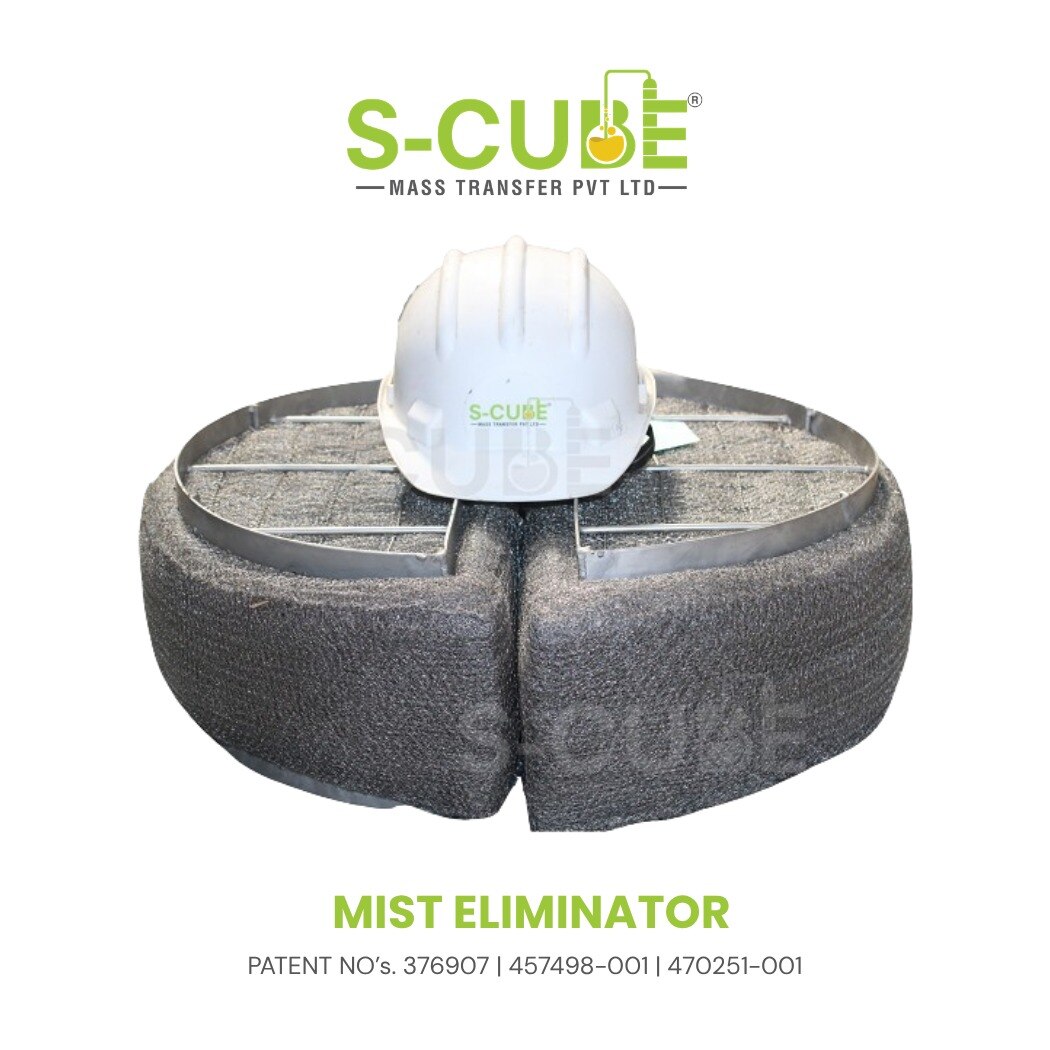
Gas leaving a scrubber, absorber, evaporator, or separator vessel can carry liquid droplets into equipment that was designed to handle gas or vapor. By the end, you will understand how a mist eliminator captures those droplets, where it belongs, how to select the right type, and how poor sizing causes carryover, flooding, or unnecessary cost.
Key takeaways
- Mist eliminators remove liquid droplets from gas and vapor streams.
- Mesh pads suit many duties; vanes and fiber beds handle different conditions.
- Check droplet size, gas velocity, liquid load, fouling risk, and materials.
- Poor drainage or undersizing causes carryover, pressure drop, and equipment damage.
Where a Mist Eliminator Sits and What It Removes
A mist eliminator sits in the gas outlet path of a scrubber, absorber, evaporator, distillation column, or separator vessel, after gas-liquid contact and before the stream reaches ductwork or downstream equipment. What does a mist eliminator do? It removes liquid droplets carried out with the gas or vapor stream.
Entrained liquid is not the same as gas or vapor. Gas is the continuous gaseous phase leaving the equipment; vapor is a substance present in that gaseous phase, often before it condenses. Entrained liquid exists as separate droplets suspended in the flow, like fine rain carried by wind.
A mist eliminator removes those droplets without stopping the gas stream, and it does not remove molecularly dissolved liquid, condense vapor, absorb a gas, or filter dry particles.
Mist eliminator explained in operating terms:
- The gas or vapor enters the outlet section carrying suspended liquid droplets.
- The droplets strike mesh wires, vane surfaces, or other collection elements and combine into larger drops.
- The collected liquid drains by gravity into the vessel, while the cleaner gas or vapor continues downstream.
Correct placement gives the liquid a drain path and protects compressors, fans, heat exchangers, turbines, ductwork, and emission-control equipment from carryover. A device can capture fine droplets efficiently yet fail if high gas velocity re-entrains liquid or heavy liquid loading floods the element.
How Mesh, Vanes, and Fiber Beds Capture Droplets
A mist eliminator explained in practical terms: it separates liquid by making droplets hit a surface while the gas or vapor follows an open flow path. The impact slows the droplets, which merge into larger drops and drain downward by gravity.
It does not remove molecularly dissolved liquid, so it cannot replace an absorber, condenser, or particulate filter.
The main designs use different capture mechanisms:
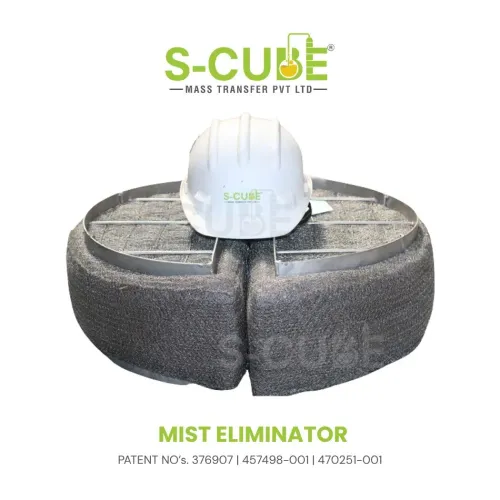
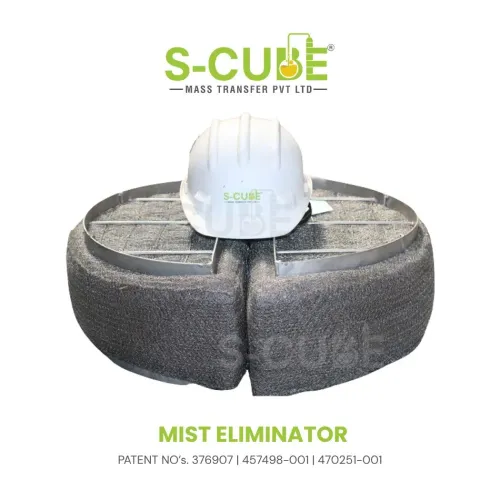
- Mesh pads force the stream through a dense bed of knitted wire or plastic filaments. Droplets strike the wires, spread, coalesce, and drain through the pad. They capture fine droplets efficiently, but excess liquid, solids, or high gas velocity can plug the mesh or re-entrain drained liquid.
- Vane packs and chevron separators turn the gas repeatedly through angled plates. Droplets resist each change in direction and impact the vane surfaces, then flow along built-in drainage paths. Their open passages handle dirty or viscous service better than dense mesh, although fine-droplet removal depends on velocity, vane spacing, and the number of turns.
- Fiber beds pass the stream through very fine fibers. Interception, impaction, and diffusion capture smaller droplets than many conventional pads, after which the liquid coalesces and drains. The trade-off is higher pressure drop and greater sensitivity to fouling.
Selection involves three separate checks: removal efficiency, allowable gas-side pressure drop, and liquid-drainage capacity. High capture efficiency still fails in service when liquid cannot drain or is swept back into the outlet.
Mist Eliminator Applications and the Problems They Prevent
A mist eliminator earns its place when a clean gas outlet is more valuable than the liquid droplets riding out with it. Without one, carryover can corrode downstream equipment and contaminate recovered product.
The main mist eliminator applications include:
- Scrubbers: Capture water, caustic, or slurry droplets before they enter ductwork, fans, stacks, or downstream treatment equipment.
- Acid-gas systems: Limit sulfuric-acid, hydrochloric-acid, or amine carryover that would attack carbon-steel surfaces and foul instruments.
- Evaporators: Keep concentrated liquor out of the vapor line, protecting condensers and preventing valuable product from leaving with the vapor.
- Cooling towers: Reduce drift, which carries treated water and dissolved chemicals into the surrounding air and onto nearby structures.
- Compressor suction lines: Stop liquid slugs from reaching compressor cylinders, rotors, or seals, where even brief carryover can cause mechanical damage.
- Solvent recovery: Separate solvent droplets from the gas stream so the recovered vapor remains cleaner and solvent losses fall.
- Oil-and-gas separation: Remove hydrocarbon mist from gas leaving a separator, protecting pipelines, meters, compressors, and gas-treatment equipment.
These mist eliminator applications succeed only when collected liquid drains away instead of pooling above the element and being swept back into the gas. That is why use a mist eliminator: it protects equipment while recovering liquid that would otherwise become waste, corrosion, fouling, or emissions.
How to Choose the Right Mist Eliminator
Choose the device against droplet size, liquid loading, allowable carryover, and pressure-drop limit—not gas flow alone. Across mist eliminator applications, confirm gas and liquid densities, viscosity, surface tension, temperature, pressure, turndown, solids content, and corrosion conditions before selecting a design.
| Option | Droplet and gas-flow fit | Loading and fouling | Pressure drop and materials |
|---|---|---|---|
| Mesh pad | Fine droplets; compact equipment and steady, moderate gas velocity | Floods or re-entrains liquid at high loading; solids and viscous liquids foul the wires | Low pressure drop when clean; specify support and corrosion-resistant wire |
| Vane pack | Medium-to-large droplets; high gas flow and broad flow passages | Better drainage and tolerance of dirty, viscous, or solids-bearing service | Pressure drop rises with velocity and tighter spacing; select alloy or coating for the liquid |
| Cyclonic separator | Coarser droplets; high gas throughput and robust bulk separation | Handles high liquid loading and solids better than fine-element designs | Pressure drop depends on swirl and outlet velocity; check erosion and corrosive wet surfaces |
| Fiber-bed unit | Very fine droplets and strict outlet-carryover limits | Low liquid capacity; plugging and blinding follow oil, solids, or viscous contamination | Higher pressure drop; verify fiber compatibility with temperature, solvent, acid, and oxidizer |
Match the choice to gas velocity at maximum flow and turndown. A design that captures fine droplets at full load can lose efficiency at low velocity, while excessive velocity drives collected liquid back into the gas. Check drainage paths and the vessel’s liquid-removal arrangement as carefully as capture efficiency.
A fiber bed or mesh pad is the wrong choice when the liquid cannot drain continuously.
Sizing, Drainage, and the Cost of Getting It Wrong
An undersized mist eliminator pushes gas above its design velocity. The result is liquid carryover, higher pressure drop, flooding, and re-entrainment when collected droplets are swept back into the gas stream. An oversized unit costs more, occupies more vessel area, and may perform poorly if low gas velocity prevents effective droplet impaction.
Confirm these details before freezing the specification:
1. Record minimum, normal, and maximum gas flow; operating pressure and temperature; gas and liquid densities; droplet-size range; liquid loading; viscosity; solids content; and the required outlet carryover. A Souders–Brown check uses Vmax = K[(ρL − ρV)/ρV]½, but obtain the K value from the supplier’s design basis rather than applying a generic constant.
2. Draw the drainage route. Collected liquid needs an unobstructed path to a sump or downcomer, with adequate clearance below the element. Check drain holes, support grids, clips, access covers, and liquid level above the pad; blocked drainage turns a correctly selected device into a separator failure.
3. Ask for calculated pressure drop, removal efficiency against a stated droplet size, design velocity, turndown limit, liquid-drainage capacity, materials for mesh or vanes, frame, welds, and supports, plus corrosion allowances. Confirm whether acid mist, chlorides, caustic, amines, temperature, or solids change that selection.
4. Require drawings showing orientation, dimensions, support details, inspection access, and replacement method. S-Cube Mass Transfer Pvt Ltd can be included in a comparison for a s cube mist eliminator hyderabad search, but compare its documented design basis rather than the search phrase.
Frequently asked questions
What does a mist eliminator do in a process plant?
It removes liquid droplets carried by a gas or vapor stream after gas-liquid contact, protecting ductwork and downstream equipment.
Where does a mist eliminator sit?
It sits in the gas outlet path of equipment such as scrubbers, absorbers, evaporators, distillation columns, and separator vessels.
How do mesh, vane, and fiber-bed mist eliminators differ?
Mesh pads capture droplets through wire-fiber contact and coalescence, vane packs turn the gas to separate droplets by inertia, and fiber beds capture finer aerosols through a dense fibrous medium.
How do you choose the right mist eliminator?
Compare droplet size, gas velocity, liquid loading, pressure-drop limit, fouling tendency, operating temperature, chemical compatibility, drainage, and required separation efficiency.
What happens when a mist eliminator is undersized or drains poorly?
High gas velocity can cause re-entrainment and liquid carryover, while poor drainage can flood the device, increase pressure drop, reduce separation, and damage downstream equipment.